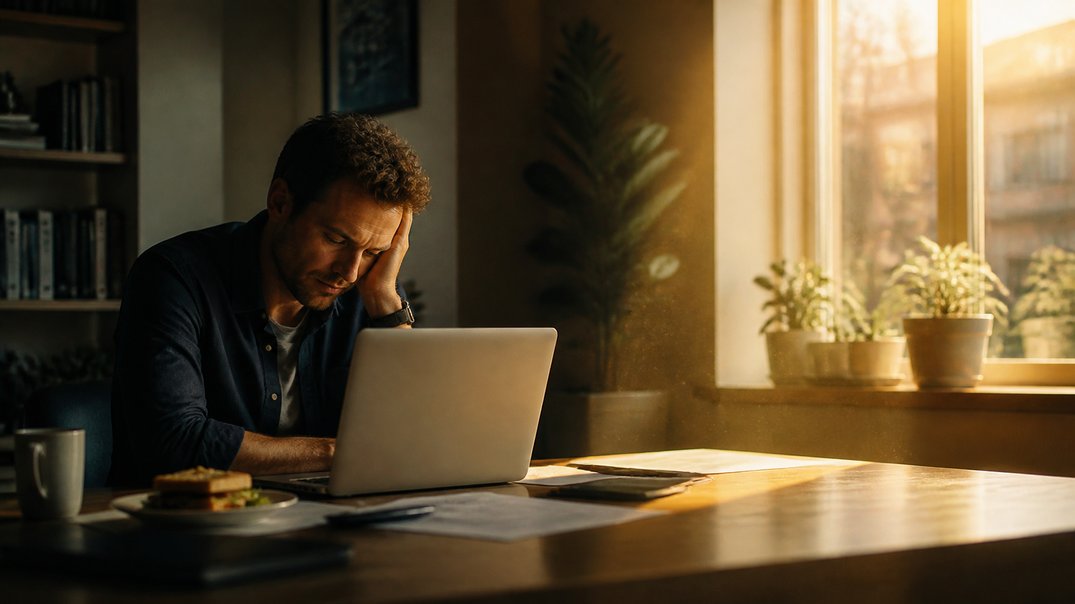
Yes, in a couple of ways. Long stretches of screen work can strain your eyes, and bright screens at night can suppress melatonin and disrupt sleep. Both can leave you more tired the next day. Regular breaks, a better setup, and an earlier screen curfew can help.
How Screens Strain Your Eyes and Body
Digital eye strain, also called computer vision syndrome, goes well beyond sore eyes. The American Academy of Ophthalmology’s EyeWiki lists tired, aching, or dry eyes, blurred vision, headaches, and neck, shoulder, and back pain, and it links tiredness to eye strain. Normal blinking is about 15 to 20 times a minute, but the rate drops during screen work, which worsens dryness.
It’s very common. The page cites survey data showing at least 60 percent of American men and 65 percent of women reported symptoms, and notes that symptoms rise significantly beyond four hours of computer use a day. Using two or more devices at once raised the share reporting symptoms from 53 percent to 75 percent.
Screens, Blue Light, and Your Sleep
The sleep effect is a second drain. Harvard Health explains that light of any kind can suppress melatonin, the hormone that signals bedtime, but blue light at night does so more powerfully. In one experiment it suppressed melatonin for about twice as long as green light of similar brightness and shifted the body clock by about three hours, versus 1.5 hours for green. Even dim light of about 8 lux, roughly a table lamp, can have an effect.
Harvard also notes that nighttime light exposure has been linked to health problems, but that this is not proof of causation. The takeaway for energy is simple: poor sleep makes the next day harder, and late-night screens can contribute to it.

Simple Habits to Protect Your Energy
A few adjustments go a long way:
- Follow the 20-20-20 rule: every 20 minutes, look at something about 20 feet away for about 20 seconds
- Take frequent short breaks, which the page says reduced discomfort more than typical longer breaks in NIOSH research
- Place the top of your monitor at or just below eye level, and keep it at least an arm’s length away
- Blink deliberately, and reduce glare from windows and lights
- Avoid bright screens for two to three hours before bed, as Harvard suggests
- Get plenty of bright light during the day to support nighttime sleep
On blue-light glasses, the evidence is mixed. EyeWiki cites a randomized trial that found no improvement in eye strain with blue-blocking lenses, and the AAO does not recommend special computer eyewear. Harvard notes that such glasses may help people who use devices at night. If you work from home, our guide to why working from home is making you more tired covers more.
When Tiredness Isn’t Just the Screen
Uncorrected vision problems, including astigmatism and presbyopia, which typically arises around age 40, can add to strain, so an eye exam is worthwhile. If you’re still exhausted after fixing your screen habits and sleep, our article on chronic fatigue versus normal tiredness can help you decide when to see a doctor.
Supporting Energy on Screen-Heavy Days
Breaks, light, and sleep do most of the work. Some people also support how their cells make energy. Performance Lab Energy is a caffeine-free formula with magnesium malate, acetyl L-carnitine, R-lipoic acid, CoQ10, PQQ, and BioPerine, ingredients involved in how mitochondria produce cellular energy. Because it has no caffeine, it won’t interfere with an earlier screen curfew and a better night’s sleep.
Frequently Asked Questions
Does Blue Light Really Keep You Awake?
Harvard Health reports that blue light at night suppresses melatonin more powerfully than other light, which can disrupt your body clock and sleep.
What Is the 20-20-20 Rule?
Every 20 minutes, look at something about 20 feet away for about 20 seconds to give your eyes a break.
Do Blue Light Glasses Reduce Eye Strain?
A randomized trial found no improvement in eye strain with blue-blocking lenses, and the American Academy of Ophthalmology does not recommend special computer eyewear.