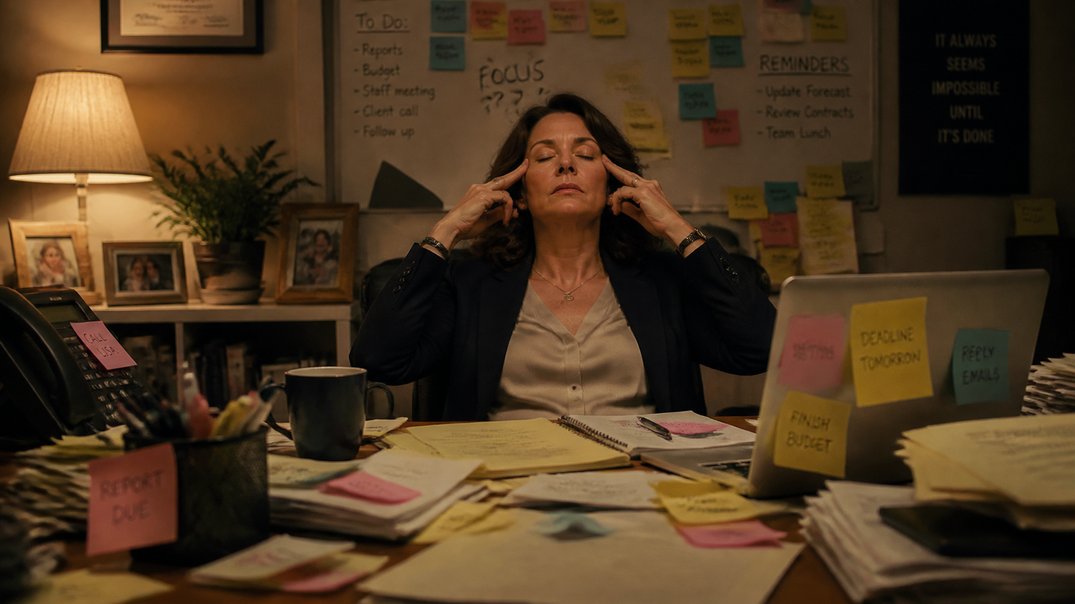
Partly. Making lots of choices can leave you feeling mentally worn out, and that feeling is genuine. But the popular idea that willpower works like a fuel tank that decisions drain has not held up well. Large, preregistered replication studies found little to no ego depletion effect, so the tiredness you feel may depend more on effort and motivation than on a depleted supply.
Where the Decision Fatigue Idea Came From
Decision fatigue is the everyday version of a psychology theory called ego depletion. The theory holds that self-control draws on a limited resource, so using it on one task leaves less available for the next. If that were true, a morning full of small choices would make you worse at resisting snacks or focusing in the afternoon.
The idea spread quickly because it matches how many of us feel at 4 p.m. after a day of meetings and inbox triage. The harder question is whether the feeling reflects a measurable drop in self-control.
What Large Replication Studies Found
When researchers pooled their efforts, the results were underwhelming. A multilab project spanning 23 laboratories and 2,141 participants did not replicate the ego depletion effect, according to a commentary on that work.
A larger preregistered effort followed. A 2021 study in Psychological Science involving 36 laboratories and 3,531 participants found no evidence of ego depletion. The confirmatory effect was negligible, and the statistical analysis favored the null hypothesis by about 4 to 1. An exploratory analysis found a very small effect, but the evidence for it was roughly even. Interestingly, the effect was somewhat larger for participants who reported feeling more fatigued.
Why You Still Feel Mentally Worn Out
None of this means mental tiredness is imaginary. The commentary notes that the tasks used in the replication often didn’t feel depleting, and that people who rated the first task as more effortful did worse on the second one. In other words, how hard something feels may matter more than any literal fuel running out.
Everyday factors pile on too: poor sleep, skipped meals, stress, and long stretches without a break. If mental fog tends to arrive with low energy, our guide to brain fog and low energy explains why the two travel together.

Practical Ways to Lighten the Mental Load
These habits are low-cost whether or not decision fatigue is a true effect:
- Settle small, repeat decisions ahead of time, such as meals, outfits, and your weekly schedule
- Batch similar tasks so you aren’t switching constantly
- Take real breaks away from screens, including a short walk
- Don’t skip meals or shortchange sleep
- Tackle your hardest, most important work when you feel freshest
Supporting Mental Energy From the Inside Out
Brains are energy-hungry organs, and some people look at supporting the way their cells make energy. Performance Lab Energy is a caffeine-free formula with magnesium malate, acetyl L-carnitine, R-lipoic acid, CoQ10, PQQ, and BioPerine, ingredients involved in how mitochondria produce cellular energy.
Frequently Asked Questions
What Is Ego Depletion?
It is the theory that self-control draws on a limited resource that gets used up. Decision fatigue is the everyday version of the idea.
Does Willpower Really Run Out?
Large preregistered studies found little to no ego depletion effect, so the fuel tank idea is not well supported.
Can Rest Help Mental Fatigue?
Yes. Sleep, regular meals, and real breaks help you feel sharper, even if decision fatigue itself is not a measurable drain.